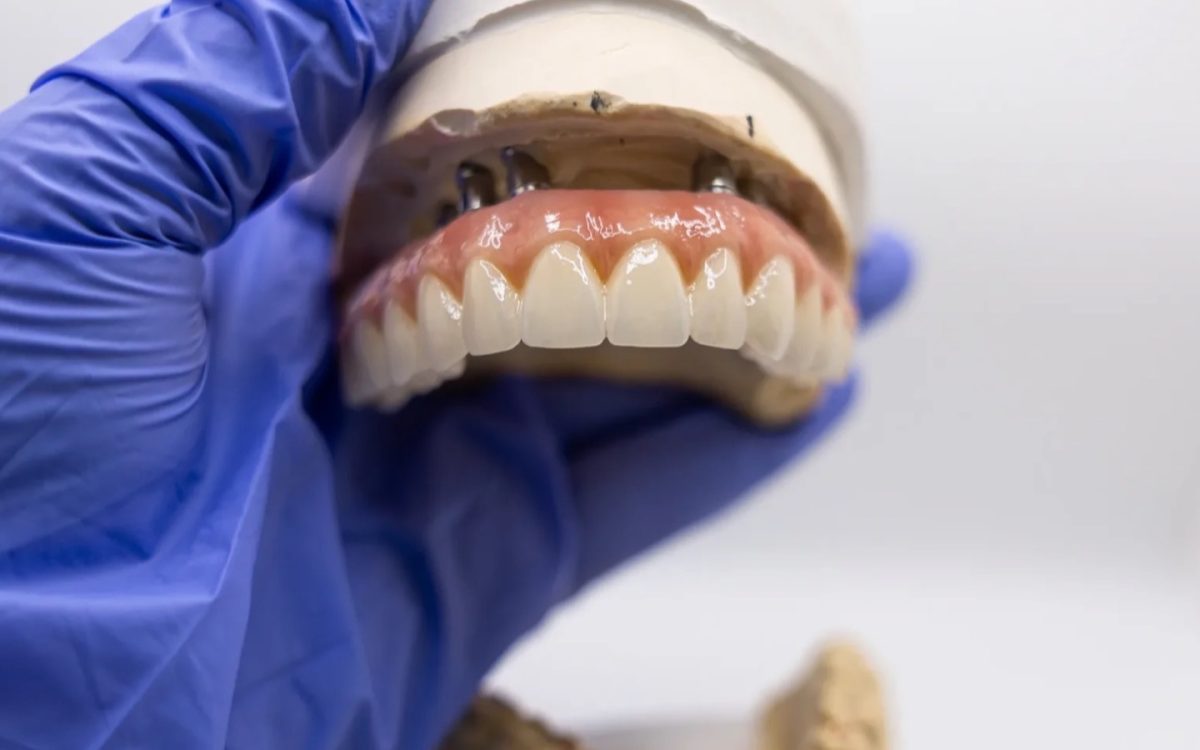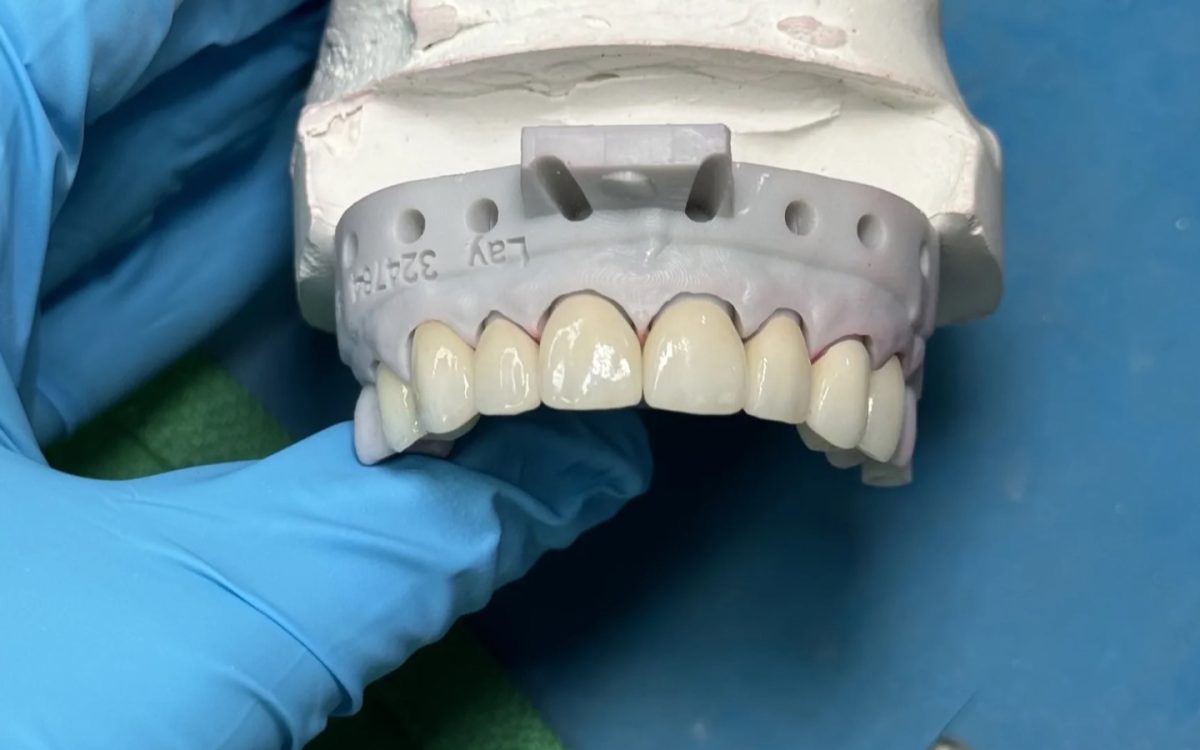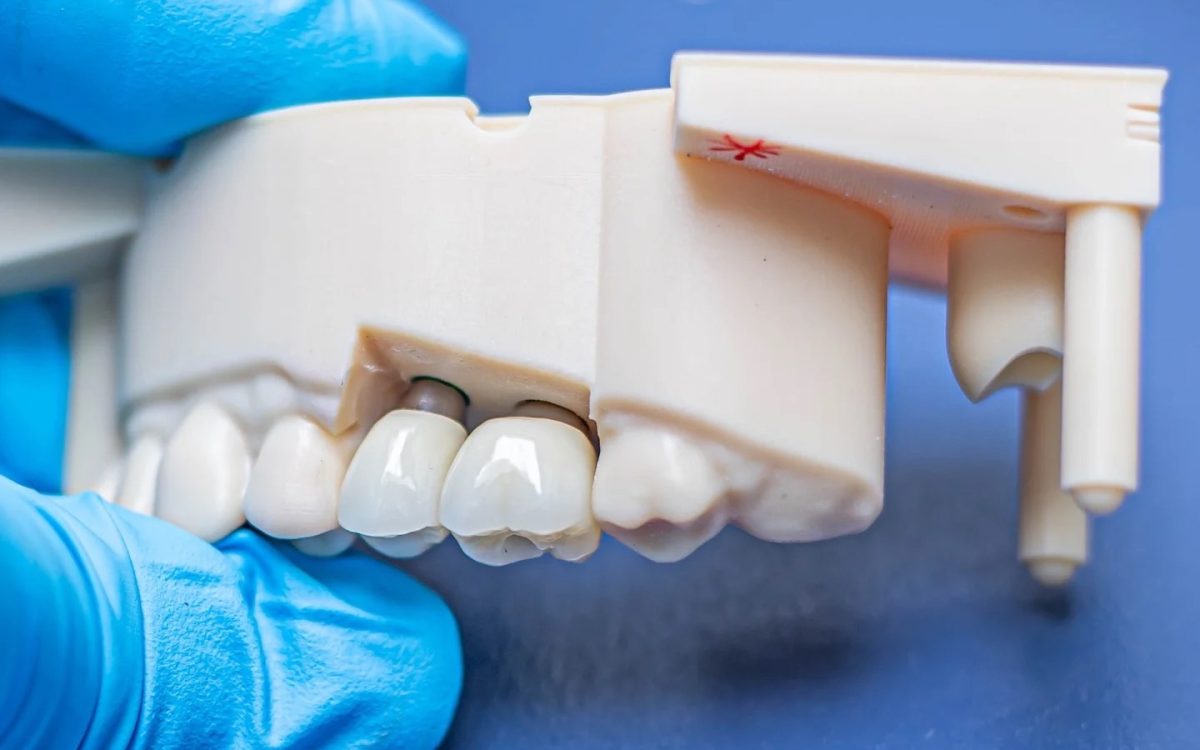
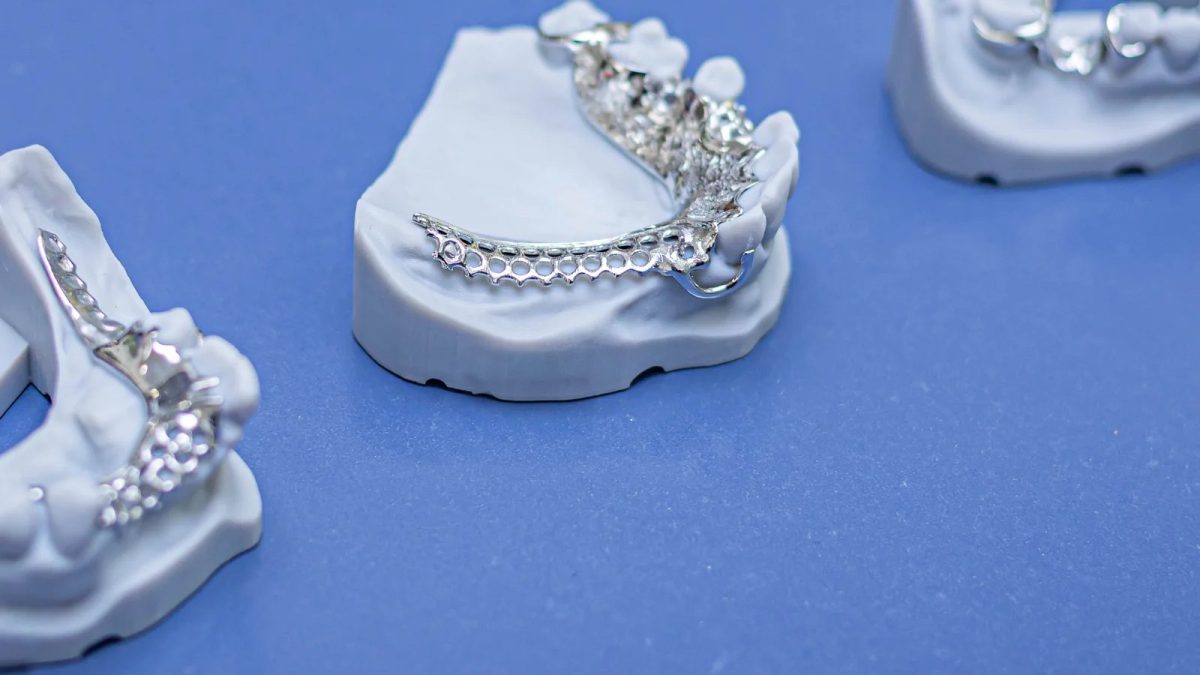
There are two families of removable partial denture clasp. Everything else is a variation on one of them. A suprabulge clasp (the circumferential or Aker’s clasp and its relatives) reaches the undercut from the occlusal, crossing the height of contour on the way down. An infrabulge clasp (the I-bar, the T-bar, the RPI system) comes up into the undercut from the gingival. Which family a tooth gets is not a preference. It is decided by where the undercut sits relative to the survey line, and the survey line is set on the cast before any metal is poured.
That is why “which clasp should I use” is a question a prescription form almost never answers. The form tells us the teeth. The surveyed cast tells us the clasp.
What the survey line actually decides
The survey line is the height of contour recorded on the cast at one chosen path of insertion. Occlusal to that line is suprabulge. Gingival to it is the undercut. A retentive arm only retains if its terminal third sits in that undercut, which is the whole mechanical basis of a cast metal partial.
Here is the part that surprises dentists: tilt the cast a few degrees and the survey line moves. Move the survey line and the undercut moves with it. So the path of insertion is not a technical detail we settle at the bench, it is the decision that determines which clasps will work, how much retention they generate, and where the metal crosses the tooth on its way to the undercut.
Change the path of insertion and you change the clasp, the retention, and whether the patient sees metal. All three, from one decision, made before anything is cast.
When a prescription arrives with the abutments circled and nothing else, we make that call. We would rather make it with you.
Which clasp goes on which tooth?
The short version, by the condition that actually selects it:
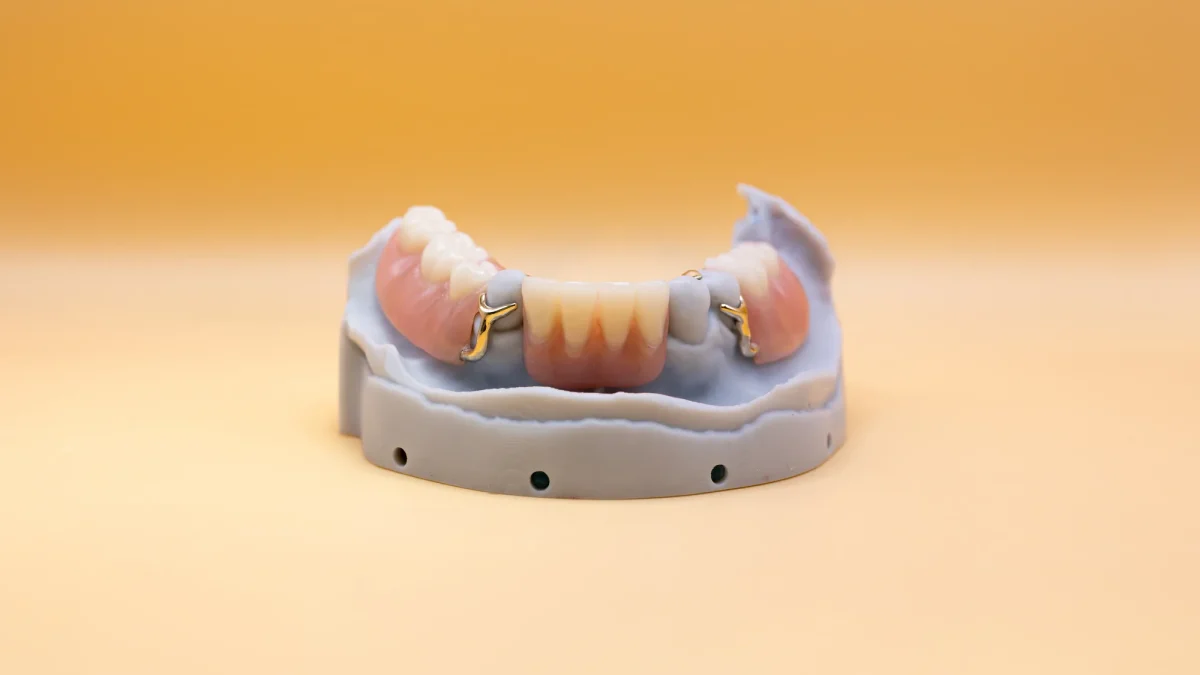
- Circumferential (Aker’s) clasp. A distal undercut on a posterior abutment, adequate crown height, no esthetic demand on the buccal. The workhorse of the tooth-supported partial. It also crosses the widest part of the buccal surface, which is precisely why it shows.
- I-bar and other infrabulge bar clasps. A mid-buccal or mesiobuccal undercut, enough vestibular depth for the approach arm, and no severe soft tissue undercut in its path. Crosses far less visible tooth than a circumferential arm.
- RPI (rest, proximal plate, I-bar). Distal extension cases, Kennedy Class I and II, where the abutment should be released as the base settles under load rather than torqued by a clasp that grips through the whole movement.
- Combination clasp. A cast reciprocal arm with a wrought wire retentive arm. The wire flexes in more directions than cast chrome cobalt does, which is what you want on a periodontally compromised abutment or a shallow undercut where a cast arm would be too stiff.
- No anterior clasp at all. A rotational path design, covered below.
Notice that four of those five are selected by undercut position and abutment condition, not by the appliance type. That is the argument for surveying before prescribing rather than after.
Where the metal shows, and the three ways to move it
A buccal clasp arm on a maxillary canine or first premolar is the most common esthetic complaint on a cast partial, and by the time the patient is looking at it in a mirror the frame is already cast. There are three real answers, and only one of them is “use flex instead”.
1. Switch the anterior abutment to an infrabulge design
An I-bar approaches from the gingival and engages a mid-buccal undercut, so it crosses a narrow strip of tooth low on the crown instead of sweeping across the widest part of the buccal surface. It needs a genuine mid-buccal undercut and enough vestibular depth. Where those exist, it is the cheapest esthetic win available on a partial.
2. Design a rotational path and delete the anterior clasp
A rotational path partial uses two paths of insertion. A rigid element seats into an anterior undercut first, then the rest of the framework rotates into place, which means the anterior abutment needs no retentive clasp arm at all. The technique is well documented in the prosthodontic literature as an esthetic alternative for anterior abutments, including in Restoring Anterior Aesthetics by a Rotational Path Cast Partial Denture: An Overlooked Technique (Sharma et al., Journal of Clinical and Diagnostic Research, 2016), and it also reduces the amount of tooth the framework covers.
The honest caveats, because they matter more than the technique: it requires the right undercut in the right place, it is harder to adjust once delivered, and a patient who cannot manage a two-stage seating motion is the wrong candidate. It is not a default. It is an option worth checking for before you accept a visible clasp.
3. Cast frame, flexible clasps on the anterior abutments
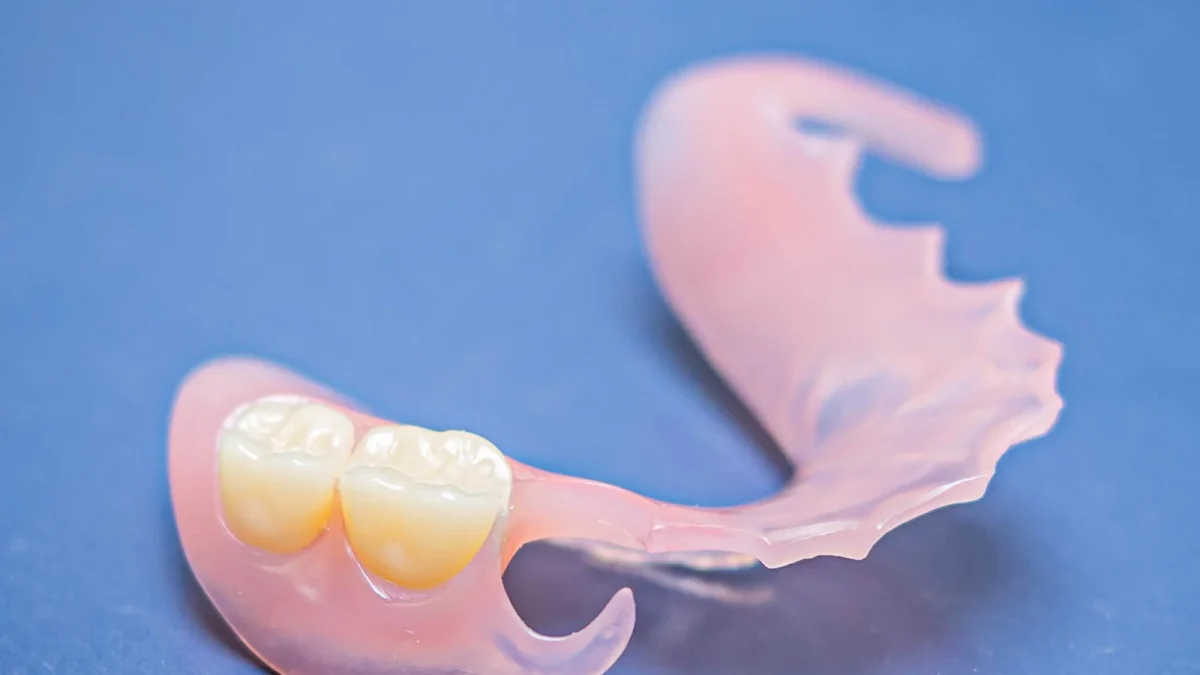
The metal carries the retention where the retention matters and the thermoplastic carries the esthetics where the patient is looking. We build these routinely. If the case is leaning that way from the start, the alternative worth comparing is a full flexible partial, which trades retention precision and service life for comfort and no visible metal. For interim and transitional cases, an acrylic partial is the honest answer and costs the patient less.
We will tell you when cast is the wrong call for a case. A partial the patient will not wear is not a cheaper partial.
Before you cast
See exactly where the clasp will sit.
Send the scan. Fifteen minutes with a technician and you have the design before anything is cast.
What we need on the prescription
Incomplete prescriptions are the single largest cause of cast partial remakes we see. None of the following takes more than a minute to write down:
- Arch and Kennedy classification. Distal extension changes the clasp design, not just the framework outline.
- Which teeth are abutments, and which of them you consider periodontally compromised.
- Esthetic priority per abutment. Not “esthetic case”. Tell us which specific tooth the patient will be looking at. That is the tooth we design around.
- Whether you have surveyed the cast, or want us to. Either is fine. Silence is the problem, because it means someone is guessing.
- The opposing arch, for the occlusal scheme and rest seat clearance.
We fabricate from any major intraoral scanner, including iTero, TRIOS, Medit and Primescan, or from a traditional impression. Details on the digital side are on our intraoral scanner page.
The codes, and the one thing offices get wrong
Reference values, and worth confirming against your current CDT set and the carrier, because insurance language varies:
- D5213, maxillary partial denture, cast metal framework with resin denture bases, including retentive and clasping materials, rests and teeth.
- D5214, the mandibular equivalent.
- D5650, add tooth to existing partial denture.
- D5660, add clasp to existing partial denture.
The mistake we hear about most often: reporting a clasp separately on a new partial. Read the nomenclature on D5213 and D5214 again. The retentive and clasping materials, the rests and the teeth are all included in the framework code. D5660 exists for adding a clasp to an appliance the patient already owns, usually because an abutment changed or retention was lost. It is not a line item on a new case, and a claim that treats it as one is a denial waiting to happen.
Common questions
Which type of partial denture clasp provides the best retention?
There is no best type. Retention is set by how deep an undercut the terminal third of the arm engages, not by the shape of the arm. A circumferential arm in an adequate distal undercut and an I-bar in a mid-buccal undercut retain comparably. Undercut position decides which one can work at all.
What are the clasps of partial dentures?
Two families. Suprabulge clasps, the circumferential or Aker’s clasp and its relatives, reach the undercut from the occlusal. Infrabulge clasps, the I-bar, T-bar and RPI system, come up from the gingival. The combination clasp pairs a cast reciprocal arm with a wrought wire retentive arm. Everything else is a variation on one of those.
What is a CC clasp?
CC is shorthand for the combination clasp: a cast reciprocal arm paired with a wrought wire retentive arm. The wire flexes in more directions than cast chrome cobalt does, which is why it suits a periodontally compromised abutment, a shallow mesiobuccal undercut, or a distal extension where a bar clasp will not fit.
Can you tell me which clasp before you survey the cast?
Not honestly. We can tell you which clasps are likely from a scan and an esthetic priority, and we can tell you within a minute of surveying whether the undercut you need is where you want it. Anyone quoting a clasp design off a prescription form alone is guessing.
Is a cast partial still the right call in 2026?
For most adult cases the patient will live with for a decade or more, yes. Retention comes from precise clasp geometry against a real undercut, and chrome cobalt holds that geometry for years. Where the patient leads with “no visible metal”, the conversation moves to flex or to a rotational path.
Will an I-bar always look better than a circumferential clasp?
Usually, on an anterior abutment, and not always. If the undercut is high and the vestibule is shallow, an I-bar approach arm can sit badly against the tissue and be more noticeable, not less. This is one of the cases where surveying first and deciding second saves the remake.
What if the undercut is not where we need it?
Then the options are changing the path of insertion, altering the tooth to create a usable undercut or rest seat, moving retention to a different abutment, or accepting a visible clasp. All four are legitimate. Which one is right is a clinical call that belongs to you, and we would rather hand you the four options with the survey information than pick one quietly.
That is the whole argument for surveying before you prescribe. Send us the case and we will work it with you. When you are ready to open an account, becoming a client takes no contract and no minimum, and we price per case.