The version of this decision most dentists were taught is a straight trade. Cement-retained wins on esthetics because there is no screw access hole to fill. Screw-retained wins on retrievability. Pick your priority.
Two things have changed that. The complication data now favours screw-retained clearly enough to make it the sensible default, and the screw access channel is no longer fixed where the surgeon left it. It can be moved, by up to 25 degrees, which resolves most of the anterior cases that used to force a cemented restoration. What is left after those two facts is a much smaller set of cases where cement is genuinely the right call, and a clear rule for when it is.
What the evidence actually shows
A 2025 systematic review and meta-analysis in Cureus (Tomar et al.) pooled seven randomised controlled trials covering 168 cement-retained and 166 screw-retained single implant-supported zirconia crowns, with follow-up from three to ten years. The findings, in order of how much they should change your behaviour:
- Screw-retained had roughly 46% fewer complications overall (risk ratio 0.54, p = 0.02).
- Screw-retained showed significantly less marginal bone loss at six months (SMD -0.63, p = 0.002). At one, three and five years the difference was not significant.
- The complications split by type as you would expect. Screw-retained accumulated the technical problems, screw loosening and ceramic chipping. Cement-retained accumulated the biological ones, primarily linked to excess cement residue.
- Bleeding on probing was similar between the two (p = 0.25).
The authors’ conclusion is deliberately measured, and we would rather quote it than improve on it: screw-retained crowns are associated with fewer early marginal bone loss and complications, but long-term bone loss and peri-implant mucosal health appear comparable between the two retention methods.
So this is not “cement-retained crowns fail”. Read properly, it says screw-retained gets you to the same long-term tissue outcome with fewer events on the way there, and that the events it does have are the kind you can fix in a chair rather than the kind that costs bone.
The cement problem is a margin depth problem
Excess cement gets blamed as if it were an unavoidable property of cementing. It is closer to a function of one variable you control.
A 2025 cross-sectional endoscopic study in the Journal of Periodontology (Montevecchi et al.) examined 46 cemented single-implant restorations that were already showing signs of peri-implant disease, using a dental endoscope rather than a radiograph. It found submucosal cement residue in 80.4% of them, 37 of 46. More usefully, position mattered: in the cases presenting as peri-implantitis rather than mucositis, the residue sat more apically (p = 0.001). That is a selected sample, every implant in it already had disease signs, so it is not a base rate for cemented crowns in general. What it does establish is that where cement is deep, it is both common and hard to see.
Hard to see is the operative phrase. The radiographic detection rates cited in that literature run around 7.5% mesially and 11.3% distally. A clean radiograph is close to no information about whether cement is down there.
And the controllable variable is margin depth. In vitro work in Clinical Oral Implants Research (Bishti et al., 2026) found that deeper crown margins left significantly greater residual cement volumes regardless of cement type or crown design, because a submucosal margin blocks both visibility and mechanical access during clean-up.
The honest rule that falls out: cement-retained is defensible when the margin is at or above the mucosal level, where excess can actually be seen and removed. Below that, you are relying on a radiograph that misses roughly nine cases in ten.
The 25 degrees that settle most anterior cases
Here is the part that removes the forced choice on the case that seems to demand cement: an anterior implant angled to the facial, where a straight screw channel would exit through the visible surface of the crown.
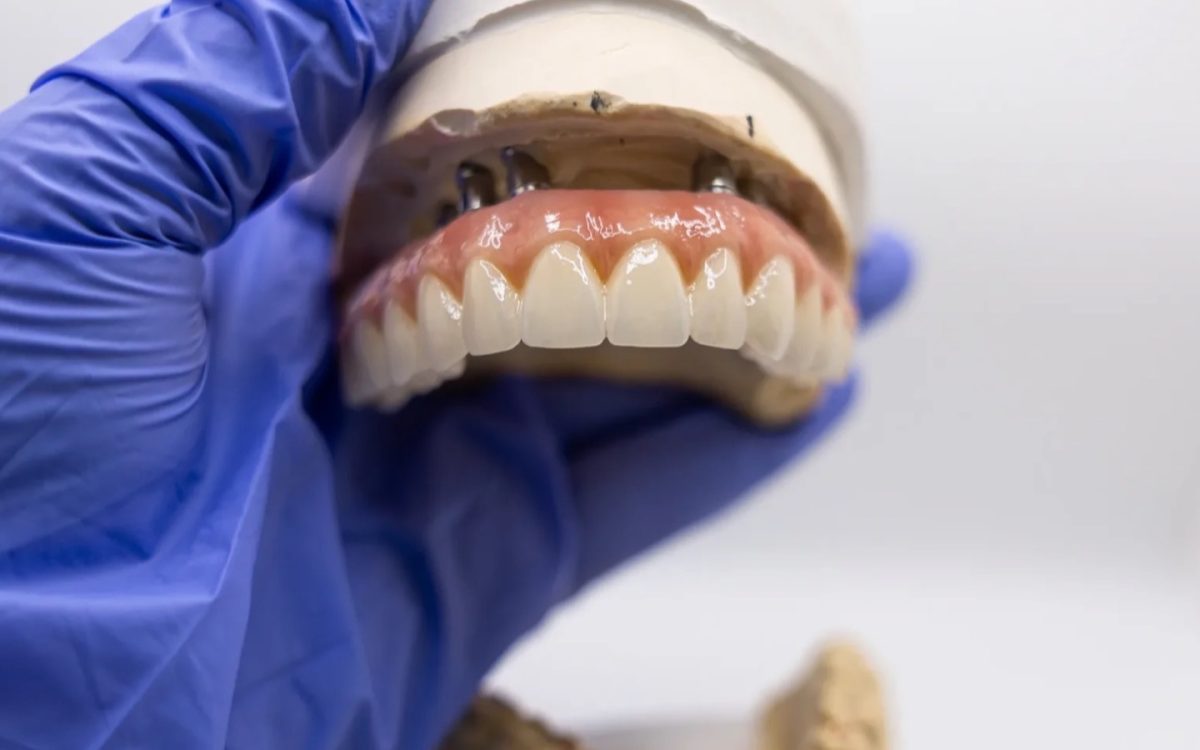
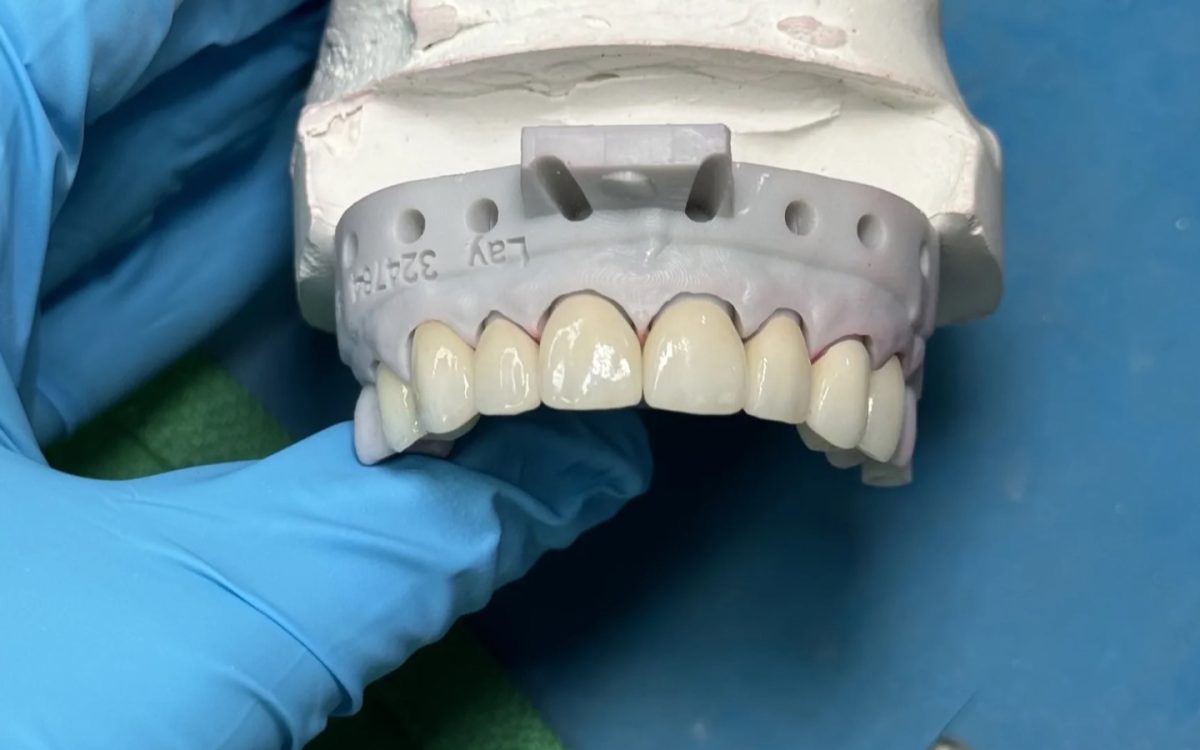
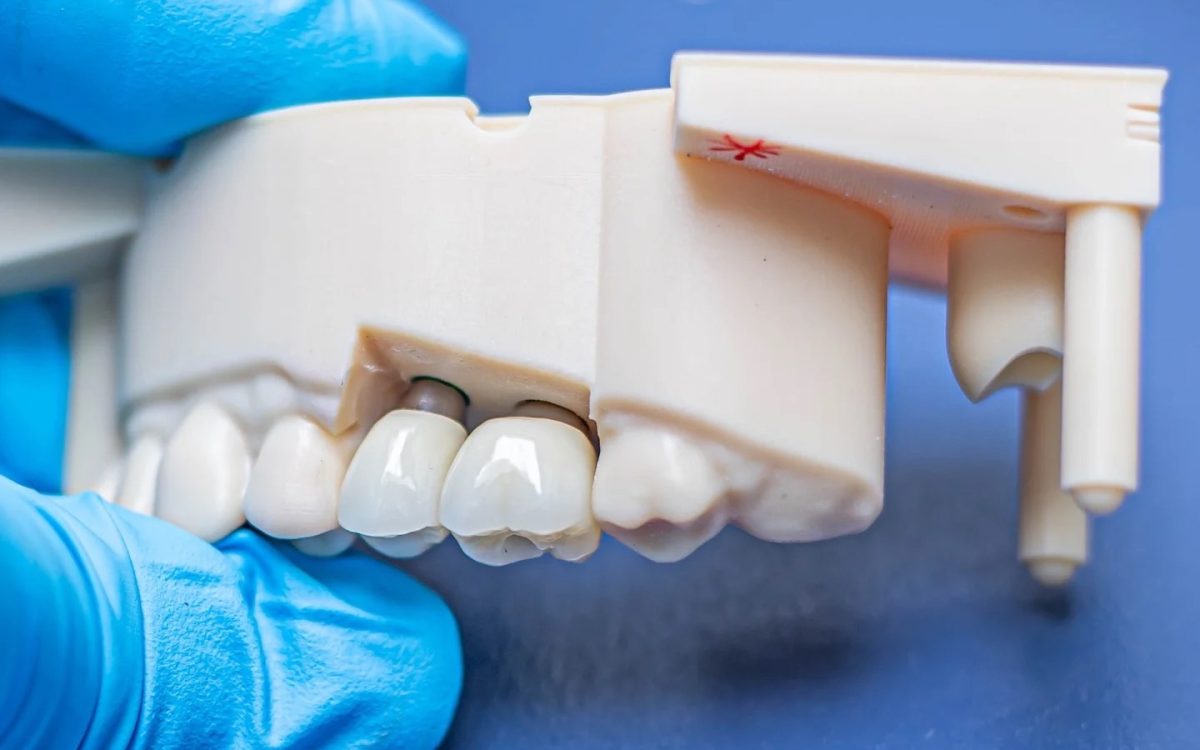
An angulated screw channel abutment redirects the access channel up to 25 degrees, through a full 360 degree radius. On the systems we work with, including Nobel Biocare and Straumann, that is normally enough to take the access from the facial of an incisor round to the palatal, where nobody sees it. The case that looked cement-only becomes screw-retained, and you keep retrievability without a filled hole in the labial surface.
The catch is timing, not capability. The channel orientation is designed into the abutment, so the decision has to be made before the custom abutment is designed, not after the crown is milled. A prescription that says “cement-retained, anterior angulation” has already closed the door on a question worth asking. See our screw-retained restorations page for the fabrication side.
So when would we still recommend cement-retained?
Three situations, and we will say so on the call rather than talk you into a screw:
- Angulation past what a channel correction reaches. Beyond roughly 25 degrees the access has to come out somewhere you do not want it, and forcing it produces an access hole in a surface the patient looks at. Cement, with a margin kept at or above the tissue.
- A multi-unit case with a path discrepancy between implants. Cementation absorbs small non-parallelism that a splinted screw-retained framework has to seat through passively.
- Where the case allows a genuinely supragingival or mucosal-level margin. If the excess is fully visible and cleanable, the main argument against cement largely goes away, and the simpler delivery flow is a real advantage.
What is not on that list: “the practice prefers cementing”, or a deep subgingival margin for esthetics. That second one is the specific combination the evidence above argues hardest against, because it maximises the cement you cannot see on the case where you are least likely to look.
Screw or cement
Can this case be screw-retained?
Send the scan. We check the angle and tell you where the screw channel would exit.
The codes, and two substitutions worth avoiding
Reference values. Confirm against your current CDT set and the carrier:
- D6065, implant supported porcelain/ceramic crown. A crown engaging the implant directly, with no separately reported abutment.
- D6058, abutment supported porcelain/ceramic crown. The crown that sits on a reported abutment, custom (D6057) or prefabricated (D6056).
- D6066, implant supported porcelain fused to metal crown (titanium, titanium alloy, high noble metal).
- D6092, re-cement or re-bond an implant or abutment supported crown.
Two things to get right. First, the retention method is not what picks between D6058 and D6065. Whether an abutment was reported is. A screw-retained crown over a reported custom abutment is D6058, and a cement-retained crown engaging the implant with no reported abutment would be D6065. Coding by “it was screwed in, so D6065” is the error we hear about most.
Second, D2920 is the natural-tooth recement code. For an implant or abutment supported crown, D6092 is the one. It is a small thing that shows up as a denial on a maintenance visit years later, which is the worst time to discover it. Material and workflow detail for the crown itself is on our implant crowns page.
Common questions
What is the dental code D6065?
D6065 reports an implant supported porcelain or ceramic crown, meaning a crown that engages the implant directly with no separately reported abutment. If an abutment is reported on the same tooth, the crown becomes D6058. Confirm against your current CDT set and the carrier.
What is the difference between dental code D6058 and D6065?
Whether an abutment is reported. D6058 is an abutment supported crown, seating on an abutment reported separately, custom under D6057 or prefabricated under D6056. D6065 is implant supported, engaging the implant directly with nothing reported underneath it.
Can D6065 and D6057 be billed together?
That pairing contradicts itself. D6057 reports a custom abutment, and once an abutment is reported the crown on top of it is D6058. D6065 describes a crown with no separately reported abutment. Report D6057 with D6058, or report D6065 on its own.
Does the access hole weaken a monolithic zirconia crown?
It removes material from the occlusal, so on a thin restoration in a heavy bruxer it is a real consideration, and it is one of the reasons we ask about parafunction on the prescription. On normal occlusal thickness it is not the failure mode we see. Screw loosening and chipping at the margin are, which matches the complication split in the meta-analysis above.
How do you fill the access channel?
PTFE tape over the screw head, then composite. The reason to care is the next retrieval: tape rather than cotton keeps the screw head clean and findable years later, and it is the difference between a five minute retrieval and a hunt.
Screw-retained on a single posterior unit, is it worth it?
Usually yes, and posterior is the easy case because the access channel lands on an occlusal surface nobody is looking at. This is where the retrievability comes free.
What if the implant is already restored and we are replacing a cemented crown?
Send us the case and the existing situation. Whether it can convert to screw-retained depends on the abutment already in place and whether it is being replaced too. If the abutment stays, the retention method usually stays with it.
Unfamiliar with any of the terms above? Our glossary of dental terminology covers the implant prosthetics vocabulary. When you are ready to send cases, becoming a client takes no contract and no minimum, priced per case.