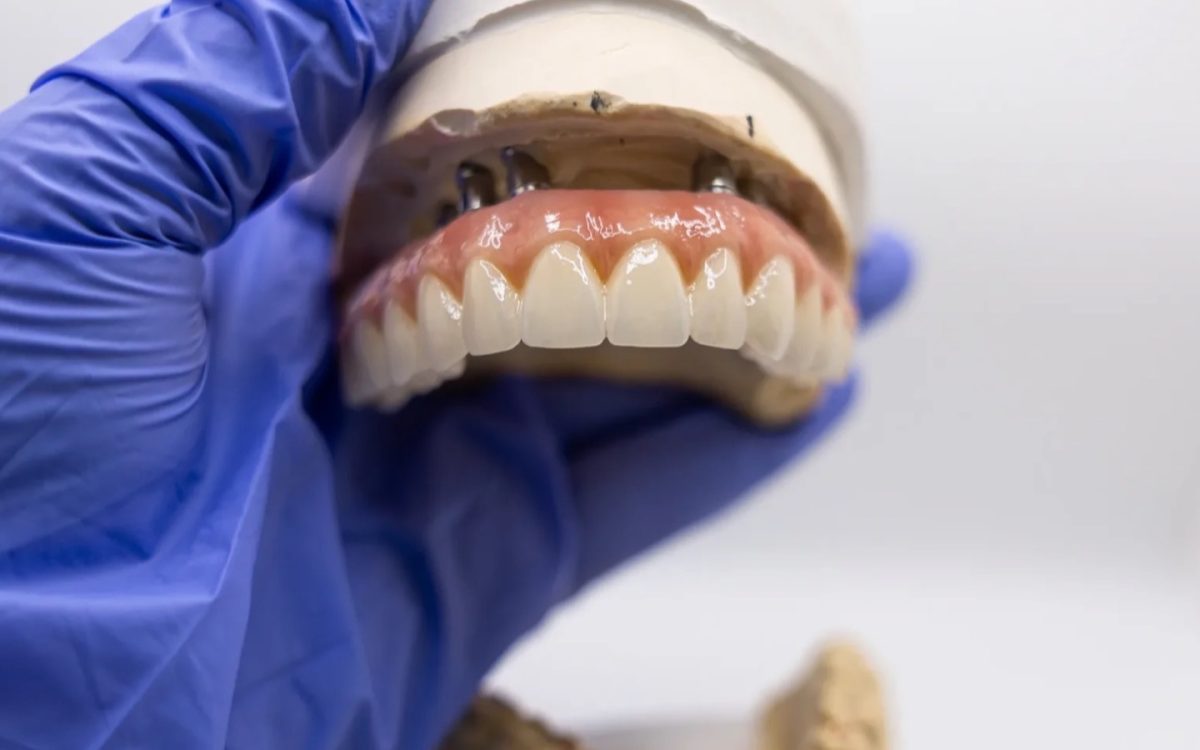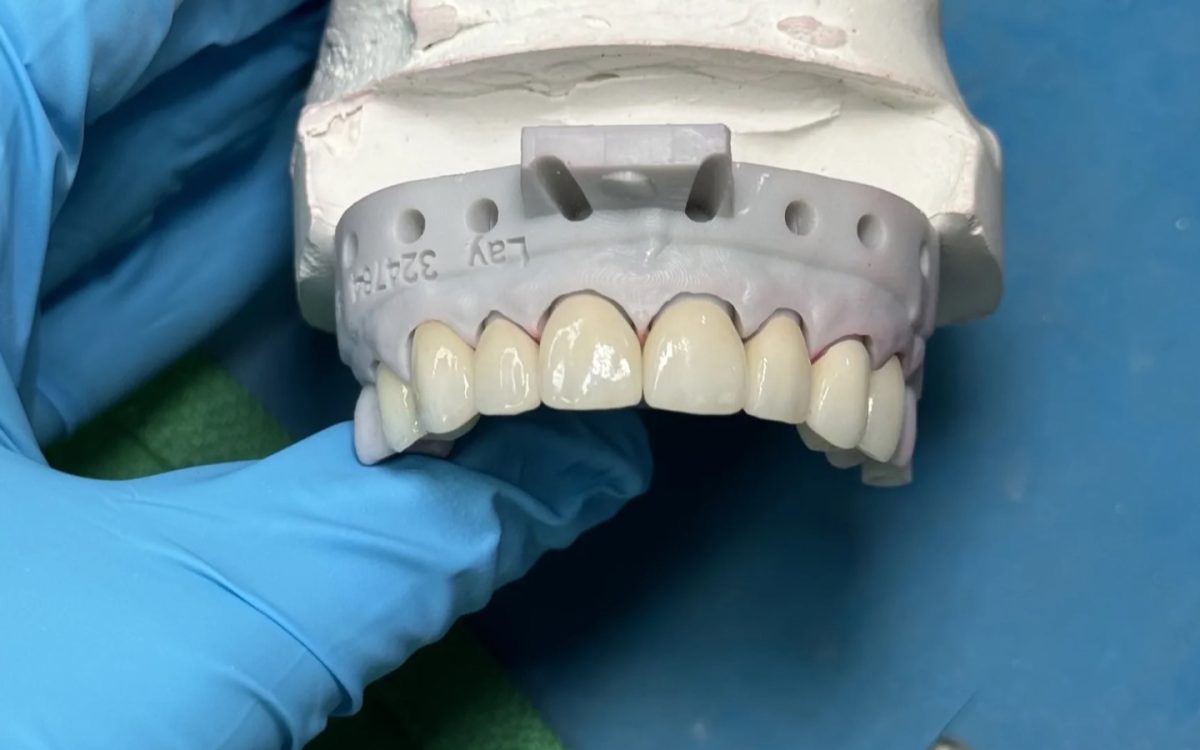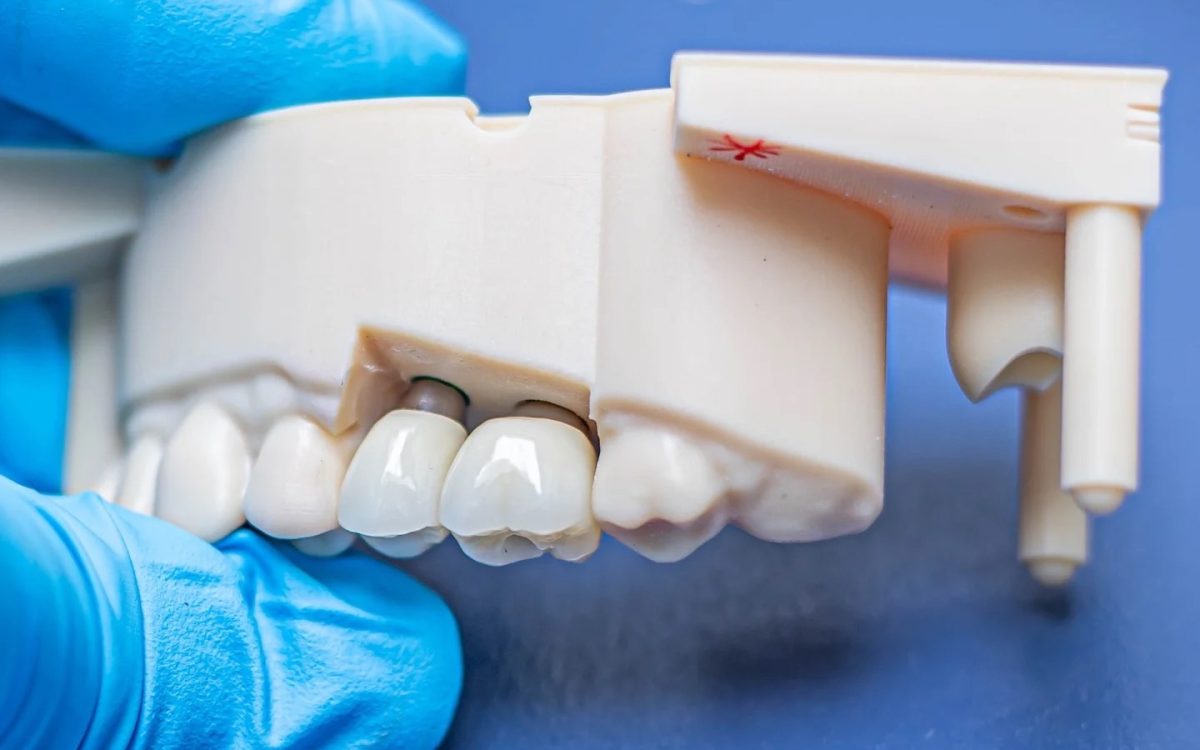
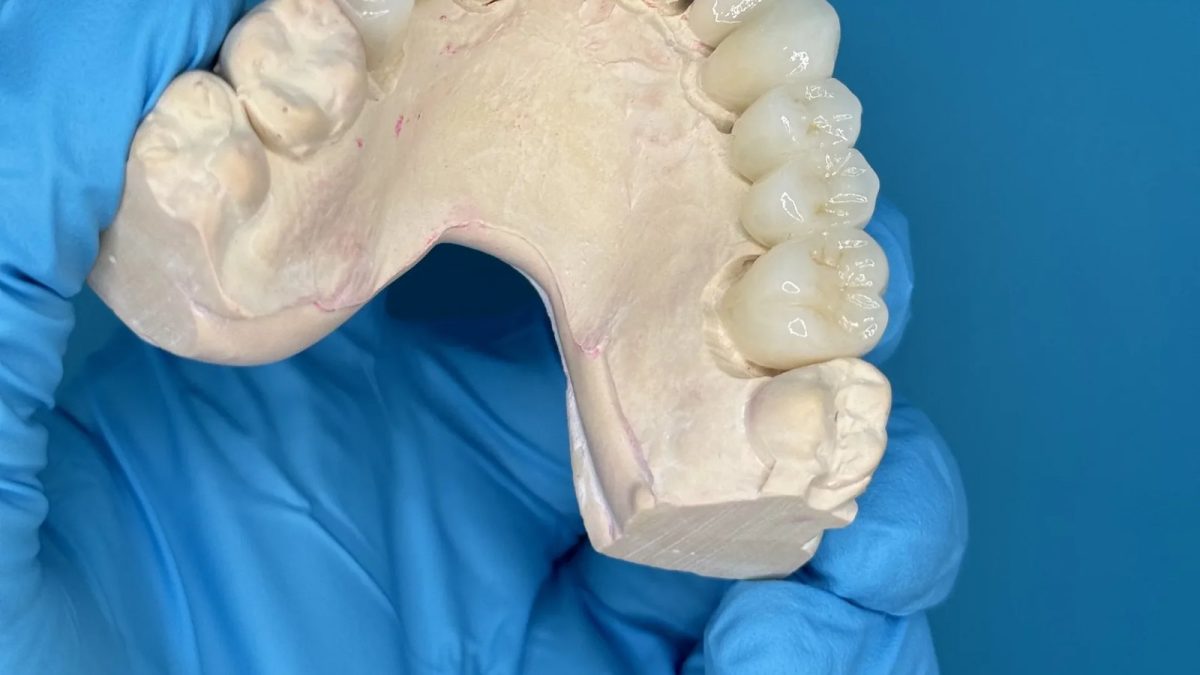
Zirconia bridges do not usually fail in the middle of a pontic. They fail at the connector, the narrow waist of material joining one unit to the next, and they fail there because that is where the stress concentrates when the bridge flexes under load. So the question that decides whether a zirconia bridge survives is not really how long the span is. It is how much cross-sectional area we have to put in the connector, and whether the case gives us room for it.
The number dentists ask for is a single minimum. There is not one. The published evidence points in two different directions depending on where in the arch you are standing, and knowing which direction applies to your case is the difference between a bridge that lasts and a bridge that comes back.
Why span length is the wrong thing to worry about first
A fixed bridge behaves like a beam supported at both ends. Beam deflection under a central load rises with the cube of the span and falls with the cube of the occlusogingival thickness. Double the span and you get roughly eight times the deflection. That relationship is why a five unit posterior bridge is not “a three unit bridge plus two”, and it is also why the fix is almost never to make the pontics stronger. Deflection is governed by the thickness of the material at its thinnest point, and on a bridge that point is the connector.
Which means the practical order of operations runs backwards from how most prescriptions are written. We do not start with the span and then design a connector to suit it. We start by finding out how much occlusogingival and buccolingual space the case actually gives us at each connector, and the span that space will support is the answer that falls out.
How big does a zirconia bridge connector need to be?
Connector size is properly discussed as a cross-sectional area in square millimetres, not a height, because a tall thin connector and a short wide one are not equivalent. The figures in the literature, and where each applies:
- 2 to 4 mm occlusogingival by 2 to 4 mm buccolingual is the general dimensional range cited for zirconia connectors (Bahat et al.).
- At least 9 mm2 with at least 3 mm of height is a common design target for anterior prostheses.
- At least 12 mm2 is the usual target once you add a cantilever or a longer span.
- 18 to 21 mm2 is what the most recent finite element work recommends for long span posterior cases, which is considerably more than the older guidance.
Those are not four competing opinions. They are four answers to four different questions, and the last two are where the interesting disagreement sits.
Posterior: the newer evidence says go bigger
A 2025 finite element analysis in Bioinformation (Lakhe et al.) modelled monolithic zirconia bridges across connector cross-sections of 12, 15, 18 and 21 mm2. On a 16 mm span under a 1,270 N load, the 12 mm2 connector generated 736 MPa of stress, which is uncomfortably close to the roughly 900 MPa tensile strength of Y-TZP. The 18 and 21 mm2 connectors held stress below 500 MPa, and the 21 mm2 design cut peak stress by about 43% against the 12 mm2 design. The authors recommend at least 18 to 21 mm2 for longer spans.
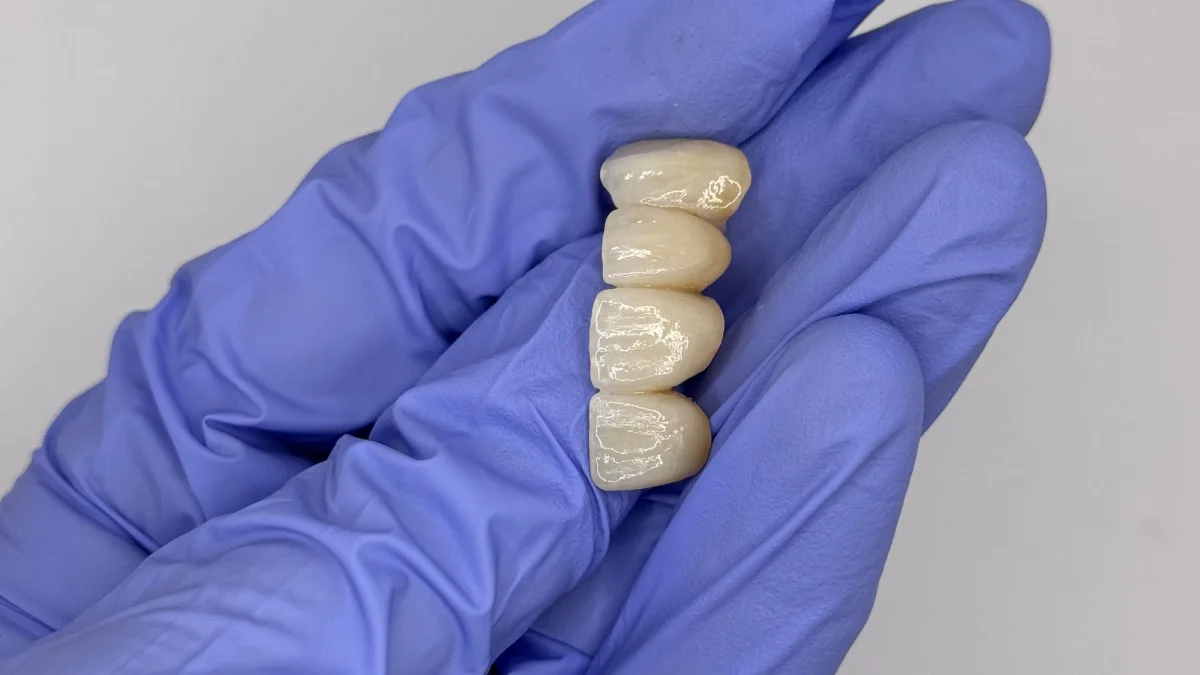
Take that as directional rather than gospel, because finite element analysis models a bridge, it does not chew with one. But the direction is clear and it matters clinically: on a long posterior span in a patient who generates real force, a connector sized to the old 12 mm2 target is running with very little margin, and posterior is exactly where you have the vertical space to do better.
Anterior: the evidence points the other way
This is the part that surprises people, and it is the reason we push back when a prescription asks for a maximum connector on an anterior case.
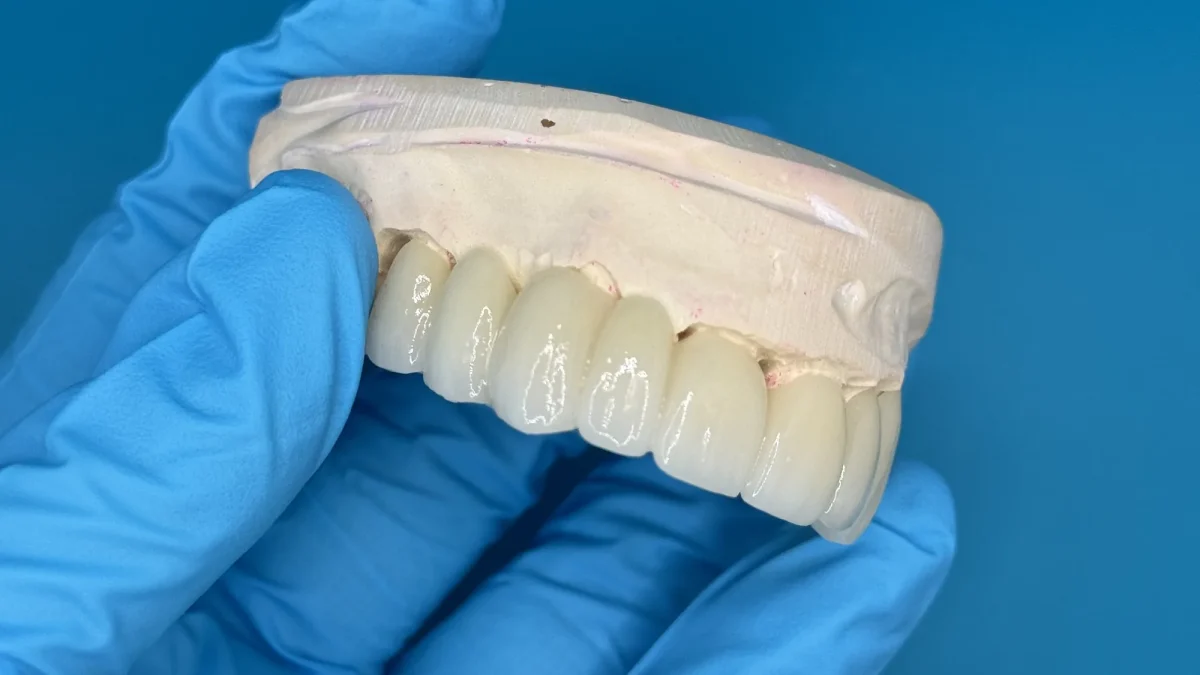
Coello and colleagues (Journal of Prosthodontics, 2023) milled 42 zirconia canine-to-canine bridges with four incisor pontics, at connector sizes of 9 and 12 mm2, across anterior cantilevers of 7, 10 and 13 mm, then cycled them 5 million times from 50 to 280 N. The difference in fracture rate between the 9 and the 12 mm2 connector was not statistically significant (p = 1.00). Fracture was not a function of cantilever length either. What the authors identified as the more important variable was retainer crown thickness, not connector thickness, and their conclusion was that a smaller 9 mm2 connector can be used to improve pontic esthetics on long span anterior bridges.
Anterior, the connector is competing with the embrasure the patient can see. The evidence says you can spend that space on esthetics and take the strength back out of the retainer instead.
Again, an in vitro trial on titanium models is not a clinical trial. But it lines up with what the bench sees: anterior zirconia bridges that fail usually fail at a thin retainer or an underprepared abutment, not at a modest connector.
Borderline span
We measure your connector space first.
Send the scan. Fifteen minutes and you have the achievable cross-section, plus an honest answer on splitting.
When splitting the case is the better bridge
Two shorter bridges are sometimes the stronger restoration, and the decision is not made on unit count. What actually decides it:
- Available connector space at the worst joint. One tight embrasure sets the ceiling for the whole span. If the case has 2 mm of vertical room at a posterior connector, adding units to that framework is adding load to the weakest point.
- Abutment condition and distribution. A long span pinned to a compromised terminal abutment concentrates everything on the tooth least able to take it.
- Parafunction. A bruxer changes the load case, not just the material choice.
- Arch curvature. Pontics set outside the interabutment axis line load the connectors in torsion as well as flexion, which is the anterior case in a nutshell.
Where the honest answer is that a single long span is being asked to do too much, we will say so on the call rather than mill it and hope. A remake is more expensive for you than a second bridge is for the patient.
Implant-supported bridges change the design and the code
Most of our implant-supported zirconia work is screw-retained, because retrievability on a multi-unit is a feature rather than a compromise, and because it keeps cement out of the sulcus. The design consequence is that the screw channels have to be planned into the occlusal surfaces before the framework is drawn, and on an angled implant that means the abutment design and the connector design are one decision, not two. That is covered on our screw-retained restorations and custom abutment pages.
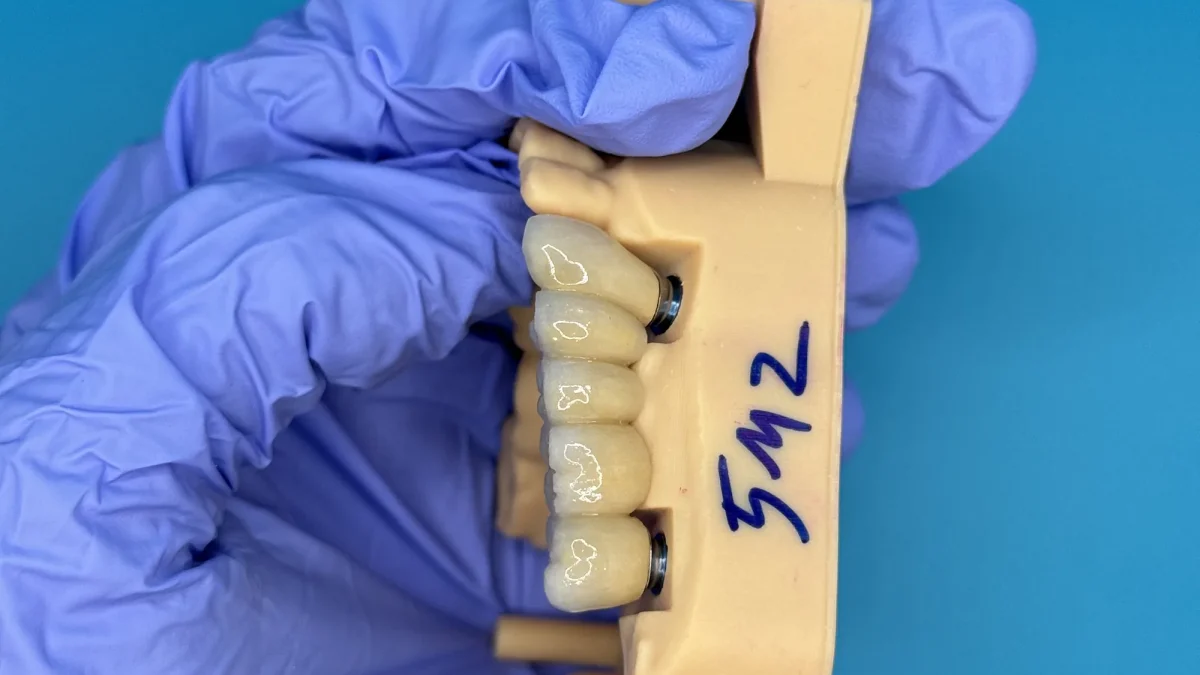
Implants also remove the periodontal give that a natural abutment provides, so a long implant-supported span transmits more of the load straight into the framework and the connectors. This is the case type where the posterior evidence above should carry the most weight.
The codes, and the one substitution to avoid
Reference values. Confirm against your current CDT set and the carrier, since insurance language varies:
- D6740, retainer crown, porcelain/ceramic. The units of a tooth-supported zirconia bridge that sit on prepared teeth.
- D6245, pontic, porcelain/ceramic. Each replacement tooth in the span.
- D6075, implant supported retainer for ceramic FPD. The retainer units of a bridge supported directly by implants.
- D6068, abutment supported retainer for porcelain/ceramic FPD. The equivalent where the bridge sits on abutments rather than the implant bodies.
The substitution worth avoiding: D6065 is a single implant-supported crown, not a bridge retainer. On a multi-unit implant-supported bridge the retainer units are D6075 or D6068 depending on whether the prosthesis engages the implants or abutments, with D6245 for the pontics. Reporting a string of single-crown codes for a splinted bridge describes a different restoration than the one you delivered.
Common questions
What is the maximum span for a zirconia bridge?
There is no single number, and any lab quoting one is quoting a policy rather than an engineering answer. The limit is set by the connector area you can achieve at the tightest joint, the abutment condition, and the load. A four unit posterior bridge with 4 mm of vertical connector space is a safer restoration than a three unit with 2 mm.
Monolithic or layered on a long span?
Monolithic, for anything long or posterior or in a parafunctional patient. Layering adds a porcelain interface on the surface most likely to see the load. Layered is for anterior multi-units where the shade has to disappear, and we would rather layer only the facial and keep the occlusal and the connectors in full-strength zirconia. See zirconia crowns for the same trade-off on single units.
Can you tell from the scan whether the connector will fit?
Yes, and that is the fastest useful thing we can do for a borderline case. We can measure the vertical and buccolingual space available at each proposed connector on the digital model and tell you the achievable cross-section before you commit to the span or the prep.
Does more zirconia always mean stronger?
Not where the space is not there to give. A connector overbuilt into an embrasure the patient can see is a bridge the patient may not accept, and the anterior evidence says that trade was not buying much strength. Overbuilt occlusal thickness on the retainers, on the other hand, does appear to earn its keep. Put the material where the evidence says it works.
Unfamiliar with a term above? Our glossary of dental terminology covers the prosthetic vocabulary. And when you want to open an account, becoming a client takes no contract and no minimum, priced per case.